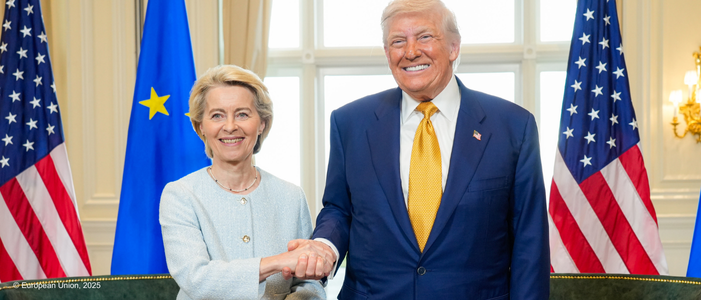
Since Donald J. Trump took office as President of the United States last January, transatlantic trade relations have been going through tensions. From the first announcement of additional tariffs on countries across the world to the latest EU-US deal, below is a quick overview of the main contention points and their state of play.
US tariffs and the EU-US trade deal
Shortly after taking office, Trump announced additional tariffs on numerous countries and regions, including the EU. The announcement of country-specific stacking tariffs has been followed by intense bilateral negotiations over their scope and amount with individual US trade partners. Focusing on the EU, in addition to the earlier-announced tariffs on steel and aluminium products, the package included a 20% tariff on all EU imports to the US (except pharmaceuticals) and a 25% tariff on vehicle imports, both of which were due to come into effect on 9 April. It is important to note that the main justification for imposing such tariffs was, and still is, the so-called ‘trade barriers’ and other measures allegedly imposed by the EU on US companies. VAT, Digital Services Act (DSA) and Digital Markets Act (DMA) are often cited as examples of discrimination against US companies. The European Commission has issued multiple statements refuting these allegations.
In response to this announcement, the EU has prepared two-fold trade countermeasures. First, retaliatory tariffs were reintroduced with regard to steel and aluminium products. Second, additional tariffs were introduced on a long list of products imported from the US to the EU. Since then, both the US and the EU have postponed the introduction of the new tariffs in order to negotiate alternatives. On 27 July, the EU and the US reached a preliminary agreement on a single, all-encompassing 15% tariff rate applicable to most EU exports, notably in the automotive, pharmaceutical, and semiconductor sectors. Numerous Member States criticised this deal. A joint statement was subsequently published, providing further details of the agreed points. Since then, the European Commission has put forward two legislative proposals, which were discussed in the European Parliament’s Committee on International Trade (INTA) on 3 September. During the discussion, the European Commission defended the deal as the best solution compared to the alternatives, stressing that the all-inclusive tariff of 15% did not allow stacking, making the outcome of the negotiations better than for some. Overall, MEPs showed little support for the agreement, calling the deal unbalanced and raising concerns over the EU’s regulatory independence. The topic of Digital Services Tax (DST) was also mentioned as a missed opportunity for the EU to have a stronger position at the negotiation table. To understand why, we need to circle back to how the arrival of Trump in office endangered the OECD framework.
The OECD framework endangered
The OECD’s global minimum tax agreement has indeed been significantly affected by Trump’s election as US President. Before Trump took office, Pillar Two of the framework, which sets the amount and scope of the corporate tax, had been agreed upon and was in the process of being implemented. However, the negotiations on Pillar One, which determines the reallocation of tax rights, were still ongoing. To ensure stability until an agreement could be reached, a multilateral convention was signed, establishing a moratorium on the introduction of Digital Services Taxes (DSTs) at the national level. The lack of agreement led the convention to expire in December 2024, which could pave the way for DSTs to be reintroduced worldwide. Last January, Trump officially declared the OECD Pillar Two ineffective in the US, undermining the whole framework. Given the US’ central role, it was, and still is, unlikely that an agreement would be reached on Pillar One and that Pillar Two would be effectively implemented.
Consequently, several EU Member States have considered the introduction of their own DST (e.g., Spain, France, Italy and Belgium). In response, Trump has threatened to impose additional tariffs on them, on top of the 15% baseline. While an effective direct taxation of multinational companies at the global level remains unlikely in today’s context, Ecommerce Europe advocates for such a solution. If this is not reachable, the EU should put forward a harmonised approach across the EU27 to prevent fragmentation of the Single Market and instability in the taxation system. In fact, DSTs across the EU currently have different scopes and amounts, which hinders the Single Market.
Next Steps
Although the EU-US trade deal provided more certainty for businesses and consumers, a lot can still change. Transatlantic relations remain unstable, and the deal itself has been criticised. Furthermore, on 5 September, the European Commission imposed a €2.95 billion antitrust fine on the US tech company Google for abusing its dominant position. US President Trump has described this as ‘very unfair’ and ‘discriminatory’. He also announced his intention to launch an investigation into the fine, which could pave the way for retaliatory measures from the US. Google has 90 days to address the issues identified by the European Commission. Ecommerce Europe will continue to monitor the situation and report accordingly.