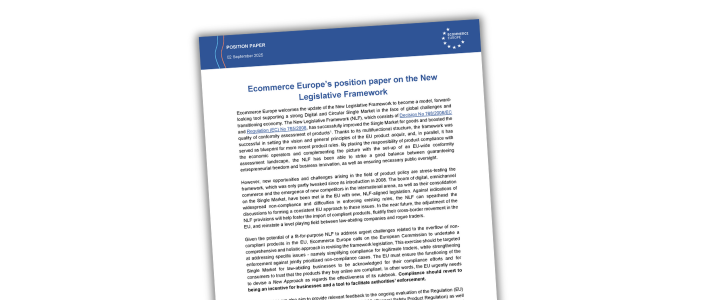
On 2 September, Ecommerce Europe submitted its contribution to the call for evidence on ensuring future-proof rules in product legislation, launched by the European Commission. Concretely, the results of the consultation will feed into the upcoming revision of the New Legislative Framework (NLF), on which a legislative proposal is expected to be put forward in the third quarter of 2026. For more background information on the NLF, you can read our previous article published in April here. In its position paper, Ecommerce Europe notably calls on the European Commission to streamline definitions and rules of the EU product acquis – with a focus on strengthening enforcement, improve the uptake of digitalisation and e-commerce, and adapt the framework to the circular economy.
Updating definitions and concepts for better enforcement
Since the introduction of the NLF in 2008, significant changes have been made to the EU product acquis, including the adoption of the General Product Safety Regulation (GPSR), the Product Liability Directive (PLD) and the Ecodesign for Sustainable Products Regulation (ESPR). Additionally, the Market Surveillance Regulation (MSR) was also adopted to replace the NLF chapter covering this aspect. Beyond these, the EU started regulating online intermediaries and platforms, such as online marketplaces. Consequently, the Digital Services Act (DSA) contains provisions directly relevant to the sale of products online, and thus, product legislation. In our position paper, we call on the European Commission to incorporate in the revised NLF the general product requirements contained in these rules, such as the definitions of ‘provider of online marketplace’, ‘fulfilment service provider’, ‘remanufacturing’, ‘refurbishing’, ‘repair’, and ‘substantial modification’. This will contribute to making the framework into an official source of guidance on the EU product acquis, for businesses, policymakers and public authorities.
Furthermore, aligning the NLF provisions with recent legislation and harmonising key definitions should provide an opportunity to take a more comprehensive approach to enforcement. In other words, the NLF should also serve as a reference provision for the minimum requirements and objectives of horizontal legislation impacting general product compliance. This approach will be key to achieving a level playing field, in particular amid the forthcoming revision of the MSR. When updating the latter and the NLF, the enforcement structure must be rethought to address the shortcomings exacerbated by the rise of global omnichannel commerce. Thus, Ecommerce Europe recommends prioritising the compliance of minimum traceability and safety requirements, harmonising authorities’ enforcement actions, and reflecting strategically on the date of application of upcoming product requirements. Additionally, product requirements should be rationalised by differentiating between the minimum traceability and safety requirements and additional, product-specific ones, based on the customs and market surveillance needs.
Supporting the circular economy
To ensure that the NLF becomes a future-proof reference text for product compliance, its scope must be as wide as possible and include circular products. This requires a transposition in the NLF of product-related tools contained in the ESPR, which became the cornerstone of the EU policy for sustainable and circular products. Notably, the NLF should include a definition of ‘second-hand product’ and the definitions and concepts reflecting circularity. Additionally, the framework can only be coherent if the rules applying to circular products take into consideration their specificities that distinguish them from new products. Some requirements, when not related to safety imperatives, cannot be reasonably expected to be fulfilled by products manufactured years before the rules came into force. In the same vein, taxation rules should be adapted to ensure they do not disincentivise the circular economy. EU product legislation should reflect the realities of the second-hand market and the diversity of business models navigating it. To achieve all these objectives, Ecommerce Europe calls on the European Commission to reflect on adapting the requirements associated with the placement and making available on the market of circular products. These two concepts are key in triggering obligations for economic operators and adjusting them could support product compliance and enforcement.
Accompanying the digital transition
In the context of the digital transition, the e-commerce sector is concerned by different policy areas with different objectives: namely those shaping the free movement of information society services (e.g., e-Commerce Directive, TRIS Directive), and later the platform economy (e.g., DSA), as well as the EU product acquis. The interplay between the diverse rules applying to online sales sometimes leads to discrepancies and incoherence in the obligations attributed to different actors, complicating the work of enforcement authorities.
For example, a provider of an online marketplace acting as an intermediary is not able to assess the physical product aspects to determine its compliance with safety standards, and they would never hold the product ‘in their hands’. However, they have a role to play in making their best efforts to ensure that the digital content hosted on their platform is compliant (i.e., the product offer). The fact that a product is offered online triggers a set of obligations linked to the concept of ‘making available on the market’ mentioned above, but does not necessarily trigger the concept of ‘placing on the market’, which is linked to a different set of obligations. This might create difficulties for authorities to track back the compliance with the different obligations and the fulfilment of the different product requirements.
Ecommerce Europe calls on the European Commission to clarify these concepts and situations to ensure the EU product legislation is adapted to the growing number of products that are mostly or exclusively made available online. The position paper notably contains some suggestions to boost the existing EU provisions enhancing traceability, accountability and enforceability (e.g., the EU Responsible Person), to ensure a strong chain of responsibility and support compliance.
Next steps
Ecommerce Europe will continue to advocate for the e-commerce sector, which has a key role to play in the green and digital transition. Its position paper details the points laid out in this article and provides concrete suggestions to ensure that the revised NLF is fit-for-purpose and future-proof amid the rise of digital and circular commerce. Achieving these objectives is essential to address the urgent challenges resulting from the overflow of non-compliant products imported into the EU, endangering European businesses, consumers and the transition to the circular economy.