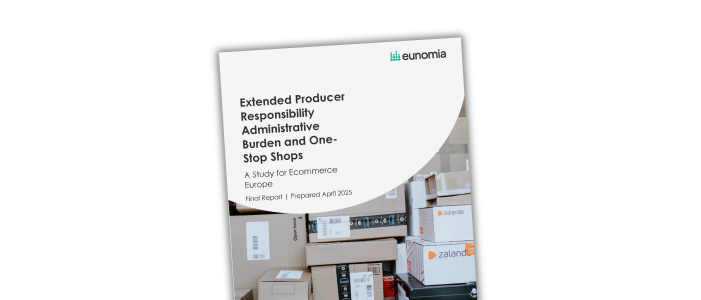
Ecommerce Europe has published a new study conducted by Eunomia Research & Consulting, highlighting the significant administrative burdens posed by fragmented Extended Producer Responsibility (EPR) frameworks across the European Union. The report, titled “Extended Producer Responsibility Administrative Burden and One-Stop Shops”, sheds light on the complexity businesses face in complying with a growing patchwork of national EPR regulations.
Luca Cassetti, Secretary General, highlighted: “Ecommerce Europe has been raising awareness on the impact of EPR fragmentation and advocating for a European solution to the growing complexity of EPR for the past years and took concrete steps to support that effort with cross-industry discussions through Project SEED[1] since last year. We therefore strongly welcome the European Commission’s commitment to addressing this issue in the future Circular Economy Act, including through a digital one-stop shop, and we believe this study will contribute to identifying where harmonisation and simplification are most needed”.
Gero Furchheim, President of Ecommerce Europe, added: “EPR schemes, while designed to ensure that producers bear the cost of managing waste from their products, have become a key barrier to trade and a drag on competitiveness, particularly for small and medium-sized enterprises (SMEs). Today, merchants are confronted with vastly different compliance obligations across Member States and within Member States, across product categories. As EPR continues to expand to new products, and the need for more granular information grows with eco-modulation, this complexity is set to worsen”.
According to Eunomia’s research, the yearly administrative effort required to meet these obligations varies greatly, with some companies reporting over 4,000 staff hours – the equivalent of 500 workdays – dedicated to EPR compliance. Nearly a quarter of companies surveyed spend over 1,000 hours annually, while over half spend at least 100 hours. The burden is most acute for SMEs, who often lack dedicated compliance staff. Instead, employees must juggle EPR obligations alongside other responsibilities, placing further strain on already limited resources. Beyond the administrative cost, the complexity of compliance is causing companies to limit or withdraw operations in certain markets, affecting consumer choice and the functioning of the Single Market.
To address these challenges, the study evaluates the potential of an EU-level EPR one-stop shop, designed to streamline compliance through a single digital platform. The report notably highlights the opportunities that centralised, accessible information on EPR obligations and a unified registration, reporting, and payment experience could bring, if accompanied by ambitious harmonisation efforts.
Dr Chris Sherrington, Head of Environmental Policy & Economics at Eunomia said: “Eunomia has long called for greater harmonisation at the EU-level of elements of EPR scheme design – notably for reporting requirements and criteria for fee modulation. While this research shines a light on the administrative effort that results from divergent approaches, the absence of a consistent signal to producers from fee modulation across all Member States also weakens the potential for EPR to drive positive environmental change. By contrast, a harmonised approach would be a ‘win-win’, both reducing administrative burden and delivering better environmental outcomes.”
Ecommerce Europe calls on EU policymakers to take stock of the extent and impact of EPR fragmentation and continue collaborating with the industry to deliver the highest level of simplification possible, while also pursuing broader harmonisation to support a truly integrated and sustainable Single Market.
[1] The SEED project is an industry-led reflection on the need for an EPR digital one-stop shop. The objective of the project is to collectively exchange on the potential features and parameters of an EPR OSS, taking into account existing requirements and stakeholders’ needs while maximising the simplification and efficiency of EPR in the EU, and to advocate for a European public solution accessible and beneficial to all.
***END***
Press contact Ecommerce Europe
Luca Cassetti
Secretary General
Tel: +32 (0) 496 273 060