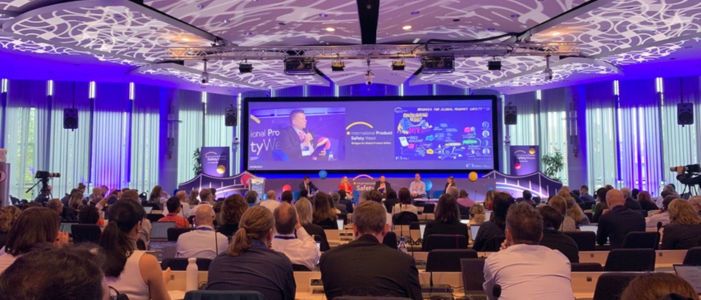
This year, another successful edition of the International Product Safety Week (IPSW) took place from 14 to 17 October in Brussels, gathering academia, experts, companies and stakeholders from all over the world to discuss pressing issues around product safety and compliance. Ecommerce Europe was among the participants – and attended multiple workshops on the agenda of the 3-day event.
Through our active participation, we learned more about the priorities of the legislators in the field of product policy and exchanged on concrete rules implementation by businesses. Overall, the event explored how all parties involved in ensuring that only safe products reach the consumers can create worldwide bridges to effectively tackle issues related to product safety.
Below you can find a few takeaways from the IPSW 2024.
Building bridges
The opening session of the event notably kicked off with a keynote speech by MEP Anna Cavazzini (Greens/EFA, Germany), Chair of the European Parliament’s on the Internal Market and Consumer Protection (IMCO) Committee and by the outgoing Commissioner for Justice Didier Reynders. Both stressed a lack of effective and efficient enforcement of EU rules on product safety, including in the e-commerce sector. Cavazzini admitted that despite recent initiatives such as the Digital Services Act (DSA) or the customs reform proposal, reality is moving faster than the EU policymaking. She acknowledged that customs and market surveillance authorities are overwhelmed by the number of imports from outside the EU and that non-EU based players, are bringing unsafe and non-compliant products onto the market, distorting the competition and harming consumers. The IMCO Chair called for fully enforcing the DSA but hinted at going beyond the Regulation – with online platforms liability likely to be touched upon by the new Parliament.
This was followed by a high-level panel with representatives from the European Commission, European Parliament, OECD and consumer organisations. Participants exchanged views on product safety, highlighting the need for better enforcement of EU legislation, stronger cooperation between national authorities and EU institutions and improving the predictability of European legislation by making it evidence-based and enforceable.
The first day of the IPSW continued with two panel discussions on “Safety and circularity” and on “New products, new risks”.
The first panel was the occasion to exchange on the application of product safety requirements to second hand products. Stakeholders discussed the importance of appropriate risk assessments in the process of making safe circular economy products available to consumers. Notably, the exchange exposed issues such as the lack of harmonisation of the safety requirements across the EU, the need for guidance for the industry, as well as the need for a more detailed framework and more specific standards.
The second panel also held discussions regarding risk assessment of product, applied this time to new technology, and specifically artificial intelligence (AI). According to some speakers, AI can present a real threat to consumers, both physically and mentally, and these stakeholders stressed the importance of anticipating and mitigating those risks by having a tailored and holistic approach. The participants notably called for a regulatory dialogue, better standards and guidance on their interpretation.
Consolidating and securing bridges
On the third day of the IPSW, the European Commission opened the discussion on the concrete implementation of the General Product Safety Regulation (GPSR), which will enter into application on 13 December 2024. The so-called Regulation (EU) 2023/988 is expected to cut down on the high flows of unsafe products entering the EU market – whose value was estimated at EUR 19.3 billion yearly. If correctly implemented, the new rules would help the EU and its Member States to save EUR 1 billion in 2025 alone. Concretely, the GPSR introduces new provisions for products’ risk and conformity assessment and safety standards for all products placed in the EU, while placing new obligations (e.g., traceability, communication with the consumers and authorities) on all players involved in the distribution chain, including online marketplaces. These rules should also enhance product recalls at the EU level.
The Commission explained that the GPSR is a “safety net”, meaning that it will apply to all products that are not specifically regulated by other EU legislation (e.g., toys, detergents and surfactants). Some provisions, such as those laying down the Safety Gate and online marketplaces’ roles will directly be applicable for sectorial legislation. Exploring the interplay between the GPSR and the Market Surveillance Regulation (Regulation (EU) 2019/1020), the Commission clarified that the obligation for a product to have an EU Responsible Person based in the EU now extends to all products.
Finally, the last panel tackled concrete initiatives that the EU and the Member States have been launching to ensure product compliance with EU laws, including for products coming from third countries. For example, the SPEAC project was mentioned, aiming to inform and accompany manufacturers based in China in interpreting and applying EU product rules. EU-based economic operators can also benefit from guidelines, notably in The Netherlands, thanks to the “Compliance Assistance Programme”, whose aim is to support companies in navigating the GPSR.
Ecommerce Europe’s continuous effort to bridge field-knowledge to policymakers
As always, the IPSW is a great platform for putting product safety at the centre of policy reflections and continue fostering worldwide omnichannel commerce. Ecommerce Europe remains committed to facilitating cross-border digital commerce in the EU by advocating for an enabling regulatory framework and contributing to a level playing field among all players. To meet our goals, we continuously work to bridge intelligence between EU-based e-commerce players and policymakers. If you wish to find out more about Ecommerce Europe’s activities, you can contact us at info@ecommerce-europe.eu.