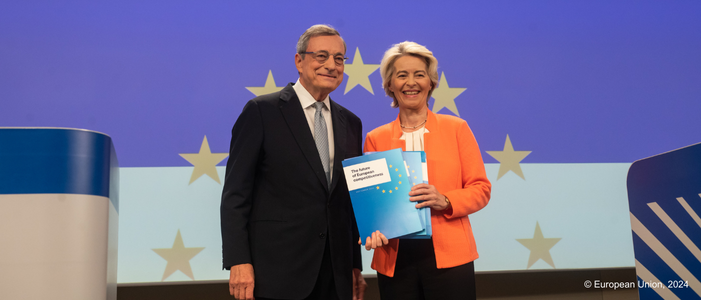
Former European Central Bank chief and Italian prime minister Mario Draghi unveiled on 9 September his much-anticipated report on the future of European competitiveness. The report advocates for a new industrial strategy for Europe, calling for unprecedented levels of investment and the introduction of new common debt to support Europe’s industrial and defence needs. The report is presented in 2 parts: Part A, available here, outlines the competitiveness strategy for Europe, while Part B, available here, contains in-depth analysis and policy recommendations.
The report highlights the EU’s weak productivity growth and the widening gap between the EU and US GDP levels. It outlines 3 major changes facing Europe today and proposes a new industrial strategy to address these challenges.
- Accelerating innovation and finding new drivers of growth. Only four European companies are among the world’s top 50 tech companies, and the EU’s global position in tech deteriorating. The EU’s share of global tech revenues fell from 22% in 2013 to 18% 2023, while the US’s share increased from 30% to 38%. In this context, Draghi underlines the need for Europe to close the innovation gap and redress the EU’s slowing productivity.
- Reducing high energy prices while continuing to decarbonise and move towards a circular economy. The report highlights how EU companies still face electricity prices that are 2 to 3 times higher than in the US and natural gas prices that are 4 to 5 times higher. To reduce energy prices and seize the industrial opportunities of decarbonisation, Draghi calls for a joint plan for decarbonisation and competitiveness.
- Navigating an unstable geopolitical environment characterised by dependencies and security challenges. To tackle these challenges, Draghi calls on Europe to enhance its security and reduce its dependencies in order to remain resilient in an increasingly volatile global context.
The report sets out the four building blocks of the proposed industrial strategy. First, it stresses the need for a full implementation of the Single Market. Second, it calls for the alignment of industrial, competition and trade policies to ensure that their they work together as part of a coherent strategy, with a focus on supporting sectors rather than individual companies. Third, massive investment will be essential to the success of the industrial strategy, which will require the mobilization of private finance. To achieve this, the report also advocates for the integration of Europe’s capital markets, enabling high household savings to be channeled into productive investments within the EU.
Lastly, the report proposes reforming EU governance, improving coordination and reducing the high regulatory and administrative burdens that hamper the competitiveness of EU businesses. It underlines how regulation is seen by more than 60% of EU companies as an obstacle to investment, with 55% of SMEs flagging regulatory obstacles and the administrative burden as their greatest challenge. The report focuses on the General Data Protection Regulation (GDPR), Due Diligence Directive (DDD), and the Packaging and Packaging Waste Regulation (PPWR) to illustrate the difficulties businesses face complying with EU law, the gold-plating of legislation by Member States, and the proportionally higher regulatory burden faced by SMEs compared to larger companies.
Proposals to address these challenges include streamlining the EU acquis under a new Vice- President for Simplification. The report also calls on the EU institutions to refocus and apply a ‘self-restraint’ principle in policymaking by filtering future initiatives and streamlining the existing acquis of EU law. It also calls for a more active use of the subsidiarity principle by national parliaments to counter the Commission’s legislative activity which has been growing excessively over the years. Overall the recommendations are closely aligned with Ecommerce Europe’s manifesto and key priorities for the new mandate. These include achieving the highest level of harmonisation across the EU Single Market, ensuring coherence across different pieces of legislation, prioritising enforcement over introducing new laws, or adopting the ‘Think Small First’ principle to work for the 90% of companies marking up our economy. You can read Ecommerce Europe’s full manifesto here.