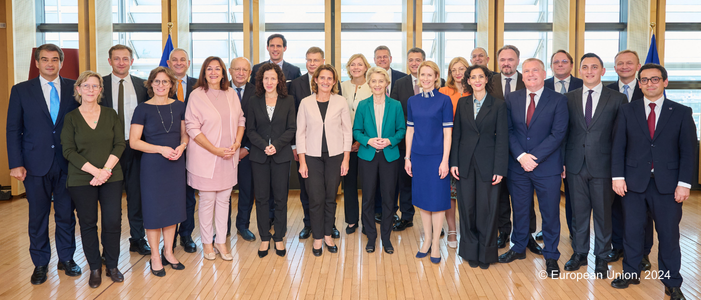
From 4 to 12 November, the confirmation hearings of the 26 Commissioners-designate, appointed under the Commission von der Leyen II mandate for 2024-2029, took place in front of the European Parliament. They provided substantial information about the intention and future regulatory activity of the European Commission with relevance to e-commerce. In line with the focus devoted to each Commissioner-designate in their mission letters, Ursula von der Leyen scattered the topics across the different portfolios. Ecommerce Europe followed the hearings and took note of discussions with high relevance to e-commerce. You will find below our key takeaways.
 Stéphane Séjourné (France)
Executive Vice-President for Prosperity and Industrial Strategy
During his confirmation hearing, Stéphane Séjourné committed to delivering a single market strategy within his first 200 days to tackle remaining barriers. He outlined the need for simplification, especially towards SMEs, for which he promised to establish an “SME Passport”. He also stressed the need to reduce the regulatory burden through impact assessments, SME filters and consultations, and harmonising the methodology across different Directorates-General of the Commission. Séjourné also expressed his support for developing the circular economy, notably with the implementation of Ecodesign for Sustainable Product Regulation and the creation of a Single Market for Waste. Finally, he recognised the pressing need for a level playing field, mentioning the Customs reform as an important step towards its achievement.
 Henna Virkkunen (Finalnd)
Executive Vice-President for Tech Sovereignty Security and Democracy
Henna Virkkunen presented a twofold approach: first, boosting and supporting innovation; second, ensuring a level playing field and a safe online space for EU citizens. To achieve this, she committed to enforcing the DSA and proposed to issue guidelines regarding the online safety of minors. She ensured to be strict towards platform transparency and responsibility in assessing and mitigating systematic risks. She also outlined the enforcement of the DSA to be a tool for achieving fair competition and a level playing field. The confirmation hearing was also driven by extensive discussions on innovation, in particular regarding high-risk AI, for which she mentioned that guidelines would be issued. Like a lot of her colleagues, one of her top priorities will be simplification and easing the reporting burden. On this point, she outlined the “business wallet” as an opportunity to achieve these goals while embracing digitalisation.
 Teresa Ribera Rodríguez (Spain)
Executive Vice-President for Clean, Just and Competitive Transition
Teresa Ribera Rodríguez opened her hearing by emphasising the EU’s strategic autonomy, innovation, and manufacturing capacity on European soil, along with the importance of a competitive economy and a clean transition. She highlighted the need to protect consumer choice and data control under the DMA, and called for its vigorous enforcement. Regarding the Green Deal, Ribera stressed the importance of reducing European energy prices to enhance competitiveness, which could be achieved through modernising the EU grid, improving interconnectivity, and boosting energy efficiency. On competition, she advocated for simplifying state aid processes to support industrial decarbonisation and innovation while protecting against unfair foreign competition. Additionally, she emphasised using tools like the Foreign Subsidies Regulation to address competitive threats from non-EU countries.
 Maros Sefcovic (Slovakia)
Trade and Economic Security, Interinstitutional Relations and Transparency (Under the guidance of EVP Stéphane Séjourné)
Maroš Šefčovič reiterated the Commission’s commitment to reducing administrative burden, stressing the importance of impact assessments, and to reducing SMEs’ reporting burden by 35%, mentioning the deployment of the SME Window.
Concerning the flood of imports from third countries into the EU, the Commissioner-designate set as a priority the establishment of a comprehensive Customs reform, committing to digitalise the customs system, address e-commerce challenges and better control a large number of parcels. In this context, Šefčovič also called for better deploying existing resources, such as better training for national market surveillance authorities. Šefčovič also plans to conduct an evaluation of the EU’s rules of origin and of the autonomous tariff suspensions and quotas schemes.
Finally, Šefčovič committed to fostering and concluding bilateral negotiations on Free Trade Agreements with key partner countries, focusing on promoting the EU’s approach to rules and standards.
 Michael McGrath (Ireland)
Democracy, Justice and Rule of Law (Under the guidance of EVP Henna Virkkunen)
Micheal McGrath assured he would oversee a stronger focus on the Single Market. He highlighted the importance of clarity and consistency in the application of the legislation, to support businesses’ technological innovations, such as AI, while ensuring data protection, notably by enforcing the GDPR and coordinating with the European Data Protection Board (EDPB).
The Commissioner-designate identified the Digital Fairness Act (DFA) as a priority, ensuring that it would fill the gaps in the existing EU legislation without replicating the rules. In that sense, the DFA will be the opportunity to address issues such as dark patterns, addictive design, and personalised behaviour.
Welcoming the upcoming application of the General Product Safety Regulation (GPSR), and the efficiency of the Digital Services Act (DSA) enforcement, he stressed the need for a consumer protection cooperation (CPC) Network and for a revision of the CPC Regulation.
Finally, regarding the Corporate Sustainability Due Diligence Directive (CS3D), McGrath acknowledged the need for supporting companies in its implementation, notably through guidelines, stakeholder consultations, and Single Help Desk.
 Jessika Roswall (Sweden)
Environment, Water Resilience and a Competitive Circular Economy (Under the guidance of EVP Teresa Ribera Rodríguez)
Jessika Roswall stressed the importance of governance and sectorial targets in reaching environmental objectives. Specifically on circular economy, she repeated multiple times that the way forward will be to implement existing legislation and harmonise national rules to make the “Single Market for Waste” happen, focusing on end-of-waste criteria. Moreover, she mentioned that market surveillance should be enhanced to ensure a level playing field among companies, notably by properly implementing the Ecodesign for Sustainable Products Regulation, including the chapter on the Digital Product Passport. Finally, she insisted that competitiveness and green transition go hand in hand and are two sides of the same coin.
 Valdis Dombrovskis (Lativa)
Economy and Productivity, Implementation and Simplification (Under the guidance of EVP Stéphane Séjourné)
Valdis Dombrovskis committed to reducing the reporting burden by 25% for companies, and specifically by 35% for SMEs. To achieve this simplification, he outlined the need to stress testing legislation on a sectoral basis or with a value chain approach, with a focus on priority areas identified as burdensome by stakeholders. He added that the simplification work will also take into consideration interplays between legislations and their cumulative effect. He also committed to applying competitiveness checks and SME tests, as well as implementing impact assessments ahead of legislative proposals. With specific regards to the CSRD and the CS3D, he recognised the necessity of addressing reporting requirements passed on to SMEs by larger companies, through simplified voluntary reporting standards, proxy data, and the introduction of a new category of small mid-caps.
He ensured that the Digital Euro will not overwhelm private payment service providers but will give the EU independence from international card schemes. He stressed that privacy will be maintained, at minimum the same level as other means of electronic payments. He reminded that offline functionality would ensure a higher level of privacy, even though the service will never reach the same anonymity as physical cash, notably because of anti-money laundering rules.
Finally, Dombrovskis expressed the EU’s commitment to OECD’s global tax framework, to ensure a fair corporate tax system. He noted the need for an agreement on Pillar One but ensured the Commission would be looking for options in case this topic would not move forward.
 Wopke Hoekstra (the Netherlands)
Commissioner for Climate, Net Zero and Clean Growth (Under the guidance of EVP Teresa Ribera)
Wopke Hoekstra stated, like Jessika Roswall, that competitiveness and climate protection are going hand in hand. He assured that a level playing field must be ensured for the industry. He wants to focus on pushing for green taxation, but also closing the tax gap and simplifying the tax system. In this sense, he will push for closing the negotiation on the Energy Taxation Directive, implementing and enforcing the EU direct tax legislation like VAT in the Digital Age and the Pillar Two Directive. He also stated being committed to a multilateral approach to digital taxation through the OECD’s Pillar One.
Hoekstra expressed his support for Commission’s ongoing initiative on taxation files and promised to push forward those “stuck in the Council”, such as HOT, BEFIT, or DEBRA. He wishes to bring more simplification to legislation without lowering standards, by engaging in a long-term dialogue with the industry. Finally, he stressed the need for a level playing field, outlining the unfair competition EU-based companies are facing in the context of the Chinese cheap products overflooding the market.
Next steps
After each hearing, the relevant parliamentary Committee chairs, together with the political group representatives, assess the Commissioners-designate and prepare their evaluation letters. These may be asked to answer more written questions or be invited for another short hearing.
On 21 November, the assessment process will be closed – and the evaluation letters are scheduled to be published after that date. The election by MEPs of the full college of Commissioners (by a majority of the votes cast, by roll-call) is currently scheduled to take place during the 25-28 November plenary session in Strasbourg (most probably on 27 November). The evaluations and MEPs voting intentions will depend on political negotiations among the EP political groups, which are still ongoing.
Photos: © European Union, 2024