For years, Ecommerce Europe has represented e-merchants’ interests in sustainability at the European level. Our goal is to convey a key message to policymakers: the e-commerce sector has a key role to play in transitioning to a competitive and circular economy.
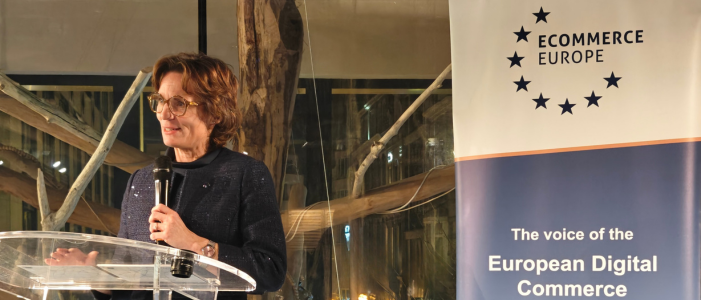
In this context, Ecommerce Europe strongly believes that the sector’s collaboration is an imperative and has maintained a constructive dialogue with the European Commission. Last week, the association celebrated the end of 2025 to reflect on the achievements of the year and discuss future ones. The event had the remarkable participation of Ms Jessika Roswall, Commissioner for Environment, Water Resilience and a Competitive Circular Economy, who delivered a keynote speech.
Looking back, this year has been eventful for the European Commission’s sustainability agenda, directly impacting e-commerce. Among the numerous milestones, the Single Market Strategy was put forward, announcing the adoption of an Environmental Omnibus and a legislative proposal for a Circular Economy Act, the implementation process of the Ecodesign for Sustainable Products Regulation (ESPR) and of the new Packaging and Packaging Waste Regulation (PPWR) was launched, and the Waste Framework Directive was published in the Official Journal of the EU. While these initiatives demonstrate the EU’s ambition to further its green transition, they also highlight an important shift in approach: the circular economy can only thrive if it is competitive. The regulatory framework must be an enabler, not an obstacle, and rules must support actors in the green transition, rather than creating barriers to their growth. To this end, the European Commission and the co-legislators are taking the necessary steps to simplify and harmonise rules as well as reduce the burden on businesses.
Drawing on these elements, Gero Furchheim, President of Ecommerce Europe, opened the End-of-Year event with a few introductory remarks, outlining the importance of simplification for the circular economy and SMEs. In her keynote speech, Commissioner Roswall highlighted the role of e-commerce in today’s society, emphasising that these stakeholders act as a bridge between producers and consumers, between technological innovation and everyday behaviour, between the global marketplace and local communities. E-merchants have the means to help citizens navigate the green transition and drive behavioural change. The Commissioner emphasised the need for e-commerce leadership, particularly in ensuring a sustainable approach to supply chains, logistics and packaging. She also recognised the sector’s potential to provide more affordable options and foster long-term relationships with consumers by offering greater access to second-hand products and contributing to the development of new circular business models. Concluding that circularity has moved from an environmental choice to an economic necessity, she stressed that e-commerce can make sustainable products accessible and attractive, and thus, make the sustainable transition appealing. In closing her speech, Commissioner Roswall stated her commitment to collaborating with the e-commerce sector to remove obstacles, to foster innovation, and to ensure that sustainable retail becomes a competitive advantage.
Commissioner Roswall then answered questions from the audience, enabling Ecommerce Europe’s members and partners to exchange views with her on ways to facilitate second-hand trade, ensure fair competition, as well as the need for practical guidance, simplification and harmonisation. Ecommerce Europe’s Secretary General, Luca Cassetti, closed the Q&A with a final question to Commissioner Roswall: “If you could have one policy wish for the e-commerce sector as the year comes to an end, what would it be?” Her answer was the same as Ecommerce Europe’s: “A level playing field for all”.