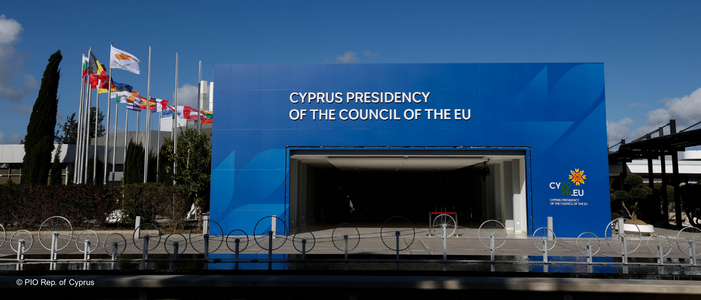
The six-month Danish Presidency of the Council of the European Union ended with the year 2025, paving the way for Cyprus’ second-ever turn to take on the Presidency, with the motto “An autonomous Union open to the world”. Presidencies are held by each EU Member States for six months on a rotatory basis, and guide the co-legislative work of the EU27 Member States. With this article, we will delve into the priorities that Cypriot Presidency has set until June 2026.
2026: the year of Omnibuses
In 2025, the European Commission presented several Omnibus packages to build on its simplification objectives. Cyprus will follow the steps of the previous presidencies of Poland and Denmark and put regulatory simplification as one of the top priorities of its mandate. The trilogues for Omnibus IV will, according to the objectives, take place in the first half of 2026. Omnibus IV includes changes ranging from ESPR modifications to standardisation and alignment of common specifications for products, to targeted amendments to the GDPR.
The recently-presented Digital Omnibus and Environmental Omnibus will also start to be negotiated. The Digital Omnibus was presented on 19 November and follows to main strands: the digital acquis and AI. The Digital Omnibus on the digital acquis includes targeted changes to the GDPR and the streamlining of the Data Governance Act and the Free Flow of Non-Personal Data Regulation into the Data Act. The Digital Omnibus on AI will include the extension of some simplifications to SMEs and SMCs, as well as linking the entry into force of rules for high-risk AI systems to the availability of support tools. On the other hand, the Environmental Omnibus includes six legislative proposals, with targeted legislative changes, a Staff Working Document (SWD) and a Communication on “Simplifying for sustainable competitiveness”. Its proposals include targeted amendments to the Batteries Regulation, speeding up environmental assessments, or the suspension of the application of the rules on the appointment of authorised representatives for EPR for waste.
The Cypriot Presidency will also start discussions on the upcoming Omnibus on taxation, announced by Commissioner Wopke Hoekstra (Climate, Net Zero and Clean Growth) in the European Parliament’s Plenary in October 2025. The Omnibus on taxation is expected for Q2 2026, and will come along with a recast of the Directive on administrative cooperation in the field of taxation and an evaluation of the Anti-Tax Avoidance Directive.
Files in the Cypriot Presidency’s roadmap
Even though Omnibuses are some of the most relevant files at the moment, Cyprus included several files relevant to e-commerce in its priorities. These files are varied and touch upon consumer-related, sustainability, digital, tax or trade matters.
Digital policy is high in the list of Cyprus’ priorities, with consumer protection being one of the most relevant topics, specifically regarding protection of children and young people in online environments. The Consumer Agenda 2025-2030 will be promoted as a tool to uphold high standards of protection, and the Cypriot Presidency plans to work on the adoption of Council Conclusions on it. Digital policy is, too, highly linked to the simplification efforts of the Commission, where the 28th regime is one of the most relevant files this year. The Cypriot presidency stated that they will begin work in the file, that is set to streamline procedures and reduce burdens for the creation of companies in Europe. Another file set to reduce administrative burdens is the European Business Wallet, that the Cypriot Presidency will advance on.
Along with a digital transition that allows for simplification, the green transition was present in the Council priorities as well through the aforementioned Environmental Omnibus and the Circular Economy Act. The Circular Economy Act aims to enhance resource management and reduce waste generation, creating a market for circular products and services. The Commission recently opened a public consultation and call for evidence for the act. The Commission Work Programme sets the Circular Economy Act for a Q3 2026 publication.
In light of the recent dynamics in international trade and tariff policy, Cyprus will strongly focus on implementing the EU-US Joint Statement. As for the Customs Reform Package, the Presidency aims to finish trilogues and reach a political agreement before Summer. An agreement on this package will be highly relevant for e-commerce, especially in the year when the removal of the €150 customs duty exemption threshold and the handling fee will start to be effective, in July and November respectively. Moreover, The Cypriot Presidency aims to finalise technical work on the revision of the proposal for the VAT rules on distance sales of imported goods and import VAT. Finally, the Cypriots will work on the Carbon Border Adjustment Mechanism (CBAM), that entered into application on 1 January, through the legal, financial, economic and political feasibility of proposed solutions to cross-sectoral issues related to the mechanism.
The digital euro, through the Single Currency Package, is on the priorities of the six-month presidency as well. After amendments were tabled in the Parliament’s ECON Committee on 12 December 2025, and the Council reached its final compromise for the file on 19 December, the Cypriot Presidency aims to start trilogues nearing the end of its six-month run. The European Parliament is expected to be vote on its plenary position on 5 May, and, if approved, the interinstitutional negotiations will start before the Summer.
Conclusions
The priorities set by the Cypriot Presidency display an ambitious program for the next months. It will be extremely important for the Presidency to find the right balance between advancing negotiations and achieving substantial progress, and the operational resources, time constraint and relative urgency of those files for the European economic security and single market resilience. Nonetheless, the Cypriot Presidency will be aided by Ireland, that is set to take over the Presidency in July. Ecommerce Europe will keep monitoring and engaging with the EU institutional and stakeholder community in line with the advocacy strategy defined with its members.