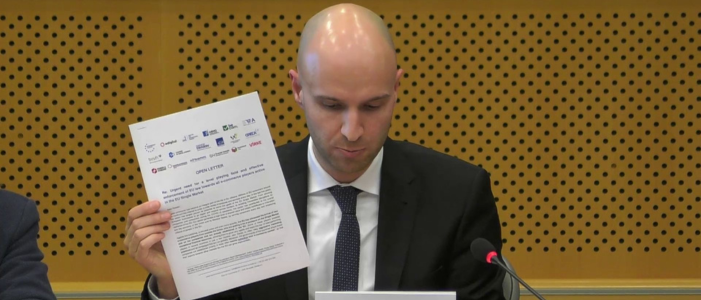
The last weeks and months have been rich in developments and institutional milestones on the topic of level playing field in the e-commerce sector. Last year, Ecommerce Europe launched an urgent call for a level playing field and effective enforcement of EU law towards all e-commerce players active in the EU Single Market, no matter where they are based. The European institutions have started gradually taking hold of the issue and discussing how to ensure that EU-based, law-abiding businesses are not put at a competitive disadvantage for the only reason that they actively seek compliance with EU rules. This principle is fundamental to boost European competitiveness as well as to increase trust in the EU policy action – especially in the current mandate, which promises to adopt this concept as a proper “compass” to guide policymakers’ action.
In this context, the European Parliament (EP) hosted two timely and insightful discussions, directly addressing the level playing field issue. On both occasions, Ecommerce Europe was asked to intervene, and managed to further advocate on this crucial matter directly in front of several Members of the European Parliament (MEPs).
IMCO hearing on “Product safety and regulatory compliance in e-commerce and non-EU imports”
On 17 February, the EP Committee on the Internal Market and Consumer Protection (IMCO) held a public hearing on “Product safety and regulatory compliance in e-commerce and non-EU imports”. Ecommerce Europe was invited to represent the e-commerce sector on the topic of challenges in compliance of e-commerce products with EU legislation.
Luca Cassetti, Ecommerce Europe’s Secretary General, presented the problem in a straightforward manner: level-playing field is the condition sine qua non for our Single Market to reward companies which respect the law and stimulate competitiveness. Two main challenges are experienced by companies when navigating the EU regulatory framework, namely regulatory barriers that hinder cross-border trade and higher compliance costs compared to non-EU based competitors, who may simply ignore EU rules without paying the consequences.
Urgent action is needed to redress the playing field, but new legislation cannot deliver on short terms, as it requires time to be adopted. Time that EU-based businesses unfortunately do not have. Priority must be given to effective and efficient enforcement of existing rules. This approach was also shared by the Commission (DG JUST) and BEUC, the European Consumer organisation. The question of enhancing enforcement of EU legislation was the main topic of the second panel, during which MEPs and other panellists raised interesting points, including addressing loopholes between different EU legal frameworks and exploring new avenues for enhancing compliance checks e.g., via digitalisation.
Overall, the outcome of this hearing was to inform the EP Own-Initiative (INI) Report on this very issue, led by Rapporteur Salvatore De Meo (EPP, Italy). The first draft of the Report, which lays out the EP IMCO’s position on non-EU imported product compliance in e-commerce, was published on 7 March and should be discussed among MEPs sitting in IMCO on 17-18 March.
Panel debate “Common Market, Equal Opportunities, Innovative Economy. How to use the potential of e-commerce for Europe’s economic growth”
The importance of ensuring a level playing field was featured in another event organised by the European Parliament recently.
On 6 March, MEP Kamila Gasiuk-Pihowicz hosted a panel debate organised by one of Ecommerce Europe’s national associations, the Polish Chamber of Electronic Commerce (e-IZBA), which involved several policymakers and experts from the e-commerce industry, notably MEP Dirk Gotink (Customs reform’s Rapporteur for IMCO), Werner Stengg (Cabinet member of Commission’s EVP Henna Virkkunen, Patrycja Sass-Staniszewska (President of e-IZBA), Agnieszka Kisielewska (Customs Expert at e-IZBA and MDDP) and finally Luca Cassetti representing Ecommerce Europe.
During the event, speakers had the opportunity to exchange on the challenges faced in the e-commerce industry due to unfair trading practices from non-EU based players, as well as the tools and measures at disposal for tackling the sheer volumes of non-compliant products being imported in the EU. Panellists discussed how the European Union can effectively support SMEs in the context of customs policy, and which tools can help ensure a level playing field in e-commerce in Europe, spanning from digital tools, AI and machine learning for customs checks, to investigations into subsidised imports from third countries, national initiatives and taskforces focused on e-commerce, and finally the Communication on safe and sustainable e-commerce published by the European Commission in February.
Ecommerce Europe will continue to strongly support EU and national decision-makers in their efforts in ensuring fair competition in the Single Market.