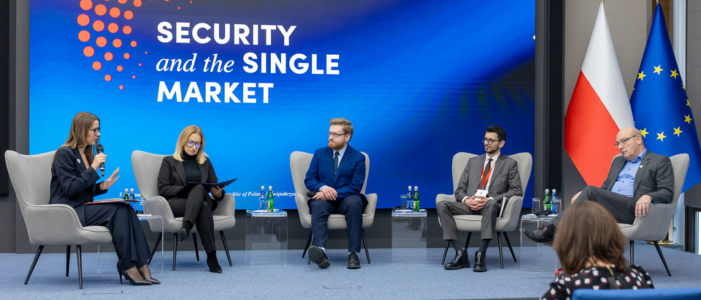
On 5 February, the Ministry of Finance and the National Revenue Administration of Poland jointly organised a conference in Warsaw themed “Security and the Single Market”. The event, centred around the need to increase security and integrity in the EU Single Market in light of today’s external challenges, hosted two panels focused on the E-commerce Communication and the EU Customs Reform.
Attended by Members of the European Parliament, such as MEP Kamila Gasiuk-Pihowicz and MEP Maria Grapini, as well as by Members of the Polish Government and Polish Parliament, and addressed by Director João Negrão of the European Union Intellectual Property Office, the Conference brought together several EU and national institutional stakeholders, customs officials and practitioners, academia and European business representatives.
Ecommerce Europe has participated in the panel on the E-commerce Communication, next to Patrycja Sass-Staniszewska, President of the Polish national e-commerce association eIZBA, Dariusz Standerski, Secretary of State in the Polish Ministry of Digital Affairs, and Frank Heijmann, Customs Counsellor of the Permanent Representation of the Netherlands to the EU. During the panel, Ecommerce Europe provided a quick overview of the progress of the commitments made in the E-commerce Communication, which had been published by the European Commission exactly one year before – on 5 February 2025. The Communication, aimed to respond to the mounting political pressure on the need to increase the level playing field in e-commerce between EU-based and non-EU based companies, lists several tools and legal instruments that the European Union has at its disposal to address the question of unfair competition from non-EU players in e-commerce. In doing so, the Communication mentions the Reform of the Union Customs Code (UCC), the Digital Services Act (DSA), the Digital Product Passport (DPP), the Extended Producer Responsibility (EPR), the Market Surveillance Regulation (MSR) and General Product Safety Regulation (GPSR), the Consumer Protection Cooperation (CPC) Regulation, and more. The Communication calls for enforcing existing rules (e.g., DSA, GPSR), finalising ongoing legislative discussions (UCC Reform), considering the revision of current rules (MSR, CPC) and advancing technical discussions under Standardisation committees (DPP). Additionally, the Communication calls for EU-wide streamlined actions to increase product safety and consumer protection, including by launching a product sweep throughout the EU and a priority control area strategy in combination between customs and market surveillance authorities.
The Communication also mentions that the European Commission would proceed with a review of the effect of those measures one year after its publication. However, it seems to be the case that the Directorate-General in charge of digital policy (DG CNECT), responsible for the Communication, will no longer publish such an update, but rather let the individual DGs publish the results of their specific actions (as happened with DG TAXUD which released the data from the priority control area in mid-January 2026, accessible here). Ecommerce Europe believes that such a general update would actually be beneficial to take stock of the progress in ensuring a level playing field for the EU companies, and addressing the existing regulatory gaps that allow an unfair competitive advantage to certain non-EU e-commerce players.
At the conclusion of the Conference, the panel on the EU Customs Reform focused instead on the need to have a data-centric approach at the EU level, enabled by the roll-out of the EU Customs Data Hub (CDH) in 2028, proposed by the UCC Reform. The Data Hub would allow customs authorities, traders and competent authorities to have access to data on the importation of every single item in real time and before it is actually delivered to the EU consumer – or even crossing the EU external border. This way, the system would permit a better and more efficient scrutiny of imports, achieved through both a shift in the responsibility for all traders involved in the delivery and supply chain, and the collaboration with the EU Customs Authority (EUCA), which is supposed to be introduced in 2028. The EU Customs Authority will ensure a consistent application of customs rules across the EU27 and will create a network of information sharing and training for the national customs authorities. Nine EU countries have presented their application to host the Authority. Poland, which proposed Warsaw and a range of 3 potential venues, is a strong candidate to host the EUCA. However, the location of EUCA is in the hands of the selection process between the EU co-legislators (European Parliament and Council of the EU), which also have yet to conclude the trilogue negotiations on the rest of the UCC reform, including the introduction of a Union handling fee, data access rights to the CDH, harmonisation of sanctions and penalties across the EU Member States, digital sovereignty of the CDH, and more. While the EUCA selection procedure should conclude in late February, the inter-institutional negotiations on the UCC Reform are expected to be finalised before the end of the current Cypriot Presidency of the Council of the EU.
The Conference on Security and the Single Market in Warsaw was a good chance to reiterate the need to conclude the negotiations on this important file, which is one of the tools, as indicated by the E-commerce Communication, to achieve a better level playing field in the EU.